

Marshall earns his place by improving the squad's damage, not by topping his own damage column. In a conventional Tank team, protect him in the back row, develop Command Strategy, and give the strongest offensive equipment to the attacker he supports. Building him like another Kimberly spends scarce materials on the wrong job.


This guide focuses on the decisions that change his value: when to replace an extra attacker with support, which Skill Medal upgrades compete with your carry, and when his exclusive weapon deserves the next shards.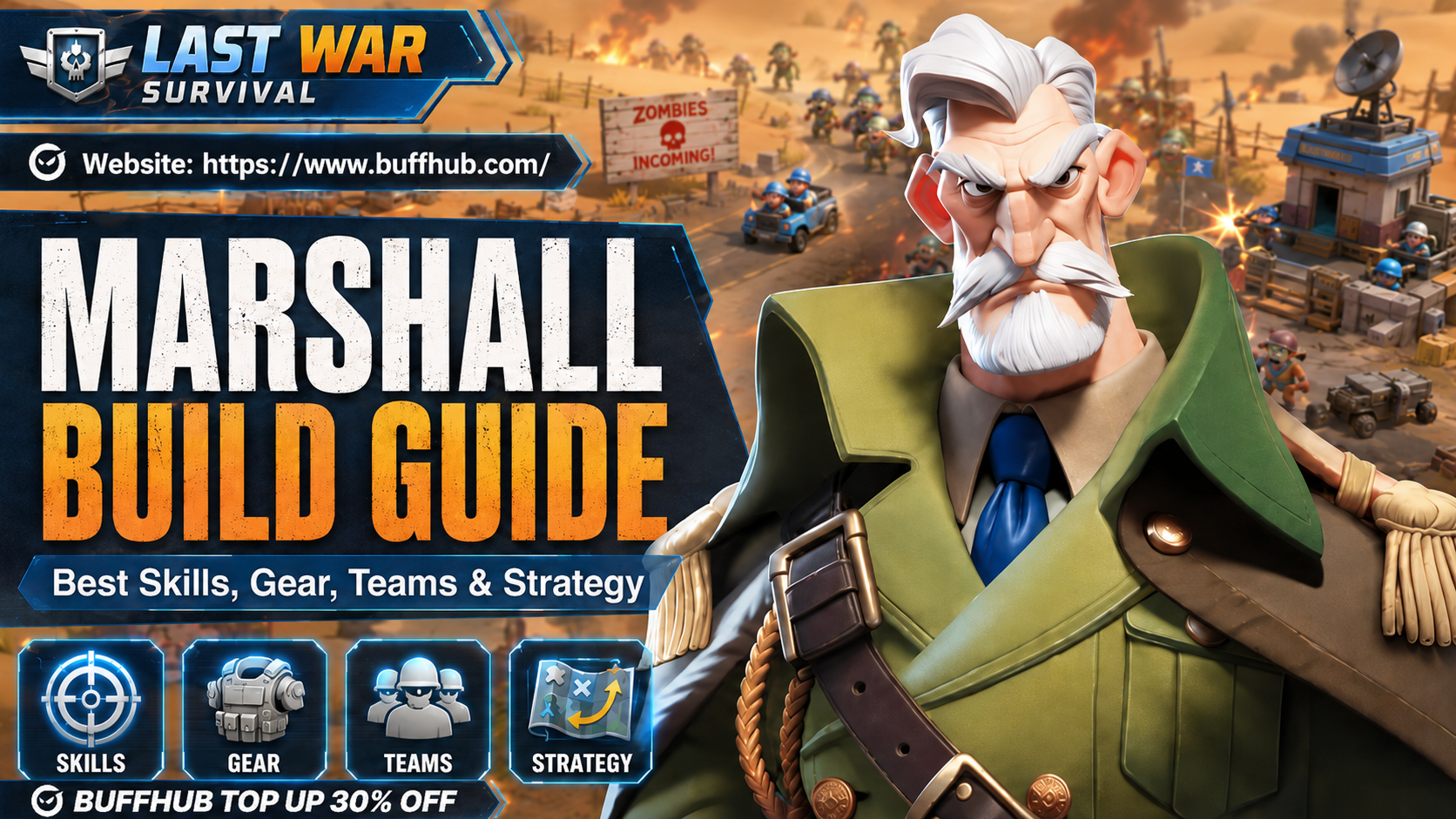




How to Tell Whether Marshall Is Helping
Compare total squad output and the survival of your main attacker when replacing a damage hero with Marshall. His own lower damage is expected. If Kimberly and the other attacker gain more useful output than the removed hero contributed, the support slot is doing its job. A report where Marshall looks weak individually can still be the stronger formation.
The reverse matters too. On an early account with underdeveloped attackers, another usable damage hero can contribute more immediately than a poorly developed buff. Do not force Marshall into the squad merely because he appears in a finished-team screenshot. Establish the damage source he will support, then evaluate the replacement using the equipment you actually own.
Use a Conventional Tank Formation as the Starting Point
| Row | Example heroes | Purpose |
|---|---|---|
| Front | Murphy and Williams | Take the opening pressure. |
| Back | Kimberly, Stetmann and Marshall | Two attackers supported by the team buff. |
This is a baseline for an established conventional Tank squad, not a requirement to own all five before using him. An earlier defender can occupy Williams's position while you develop the roster. Avoid placing Marshall in front simply because his vehicle type says Tank: the vehicle category and the defensive specialty are different.
Later seasonal mixed formations need their own evaluation. Do not combine heroes from several advanced lineup suggestions while omitting the exclusive weapons, promotion effects or seasonal conditions that made each suggestion work. Begin with one complete formation and change one role at a time.
Support Skills First, but Compare Medal Costs
Command Strategy raises the team's Attack during its buff window. Rapid Start supports skill cycling and protects the highest-Attack hero. Triad Harmony supplies Marshall's personal attack. That makes Command Strategy the usual starting priority, followed by the relevant passive development, with the ordinary attack receiving a smaller share of a limited medal budget.
In a player discussion about Tank skill priorities, contributors agreed on important support skills but challenged the idea of maxing one expensive skill before touching cheaper ranks elsewhere. Apply that distinction to your actual costs. If one late Command Strategy rank consumes the same medals as several useful upgrades on Kimberly, compare the gains rather than following a rigid list until the reserve is empty.
Super Sensing belongs to expertise progression; do not treat it as a fourth freely interchangeable Skill Medal purchase. Keep stars, ordinary skill ranks and exclusive-weapon materials separate in the plan. Reaching a requirement in one system does not mean the materials for the others are already covered.
Radar and Armor Before a Showcase Railgun
Players discussing Marshall's gear generally put Radar and Armor ahead of personal offense. The useful reason is continued support, not an obligation to reach an identical level on all four pieces. If he dies early, protect him. If he reliably survives, the next offensive piece is usually more compelling on the main attacker than on Marshall.
Before dismantling an already-upgraded gun, see whether it can be moved to an active damage hero. Community replies disagree about dismantling versus transferring because the rest of the inventory changes the answer. Moving the item preserves another useful loadout; dismantling only makes sense after checking the actual returned materials and whether that item has a job elsewhere.
Keep the gear systems distinct: ordinary gear levels use a different resource plan from blueprint promotions. Waiting for promotion materials does not require leaving every affordable regular upgrade unfinished. Conversely, spare Upgrade Ore does not make a scarce blueprint a good purchase for a low-impact support weapon.
Plan the Unlock Separately From Later Levels
Marshall's exclusive weapon arrives with Season 3 progression. Activation requires five-star Marshall and 50 named weapon shards; universal exclusive-weapon shards can be used afterward. A stockpile of universal materials therefore does not replace the initial named-shard requirement.
For a Tank main, its next milestone should compete with the other active heroes' weapon milestones. In a discussion with Kimberly already at weapon level 30, players advised spreading further investment into the supporting squad rather than continuing to concentrate every universal shard on her. The applicable lesson is to compare the next useful team effect, not to assume either Marshall or Kimberly always comes first at every stage.
Frequently Asked Questions
Should Marshall normally be in the front row?
No. In the conventional Tank setup, use dedicated defenders in front and Marshall behind them.
Does low personal damage mean he should be removed?
No. Compare the whole squad with and without his support, including the main attackers' contribution.
Should his Railgun receive the first offensive upgrade?
Usually give that investment to your main damage dealer. Marshall's survival and support skills take priority for his role.
Can universal weapon shards activate his weapon?
The initial activation uses named Marshall weapon shards; universal weapon shards are for subsequent upgrading.