

Hero Gear is one of the easiest places to waste valuable resources in Kingshot. The problem is rarely that players forget to upgrade their gear. It is usually the opposite: Enhancement XP, Forgehammers, and Mythic Gear get spread across too many heroes and too many pieces, leaving the main march with plenty of levels but no clear strength. A better approach is to decide what your march actually needs, concentrate resources on a small group of high-impact pieces, and only broaden your investment once those priorities are in a good place.


For most accounts, the basic rule is straightforward: strengthen Infantry Health first, then improve the Lethality of your strongest damage type. Armor and Gloves are the Health-focused pieces, while Helmets and Boots provide Lethality. Many players develop Archer Lethality before Cavalry, but that is a community default rather than a fixed rule. If your heroes, star levels, research, and usual formation lean more heavily toward Cavalry, upgrading Cavalry damage first can give your account better results.


How Hero Gear Works in Kingshot
Each Infantry, Archer, and Cavalry hero can equip Hero Gear, with different pieces contributing different combat stats. Gear quality progresses from lower-rarity equipment through Mythic Gear, while long-term progression eventually leads into Legendary Gear. Lower-rarity pieces are useful while an account is developing, but Mythic equipment is where long-term Enhancement and Mastery investment becomes much more important.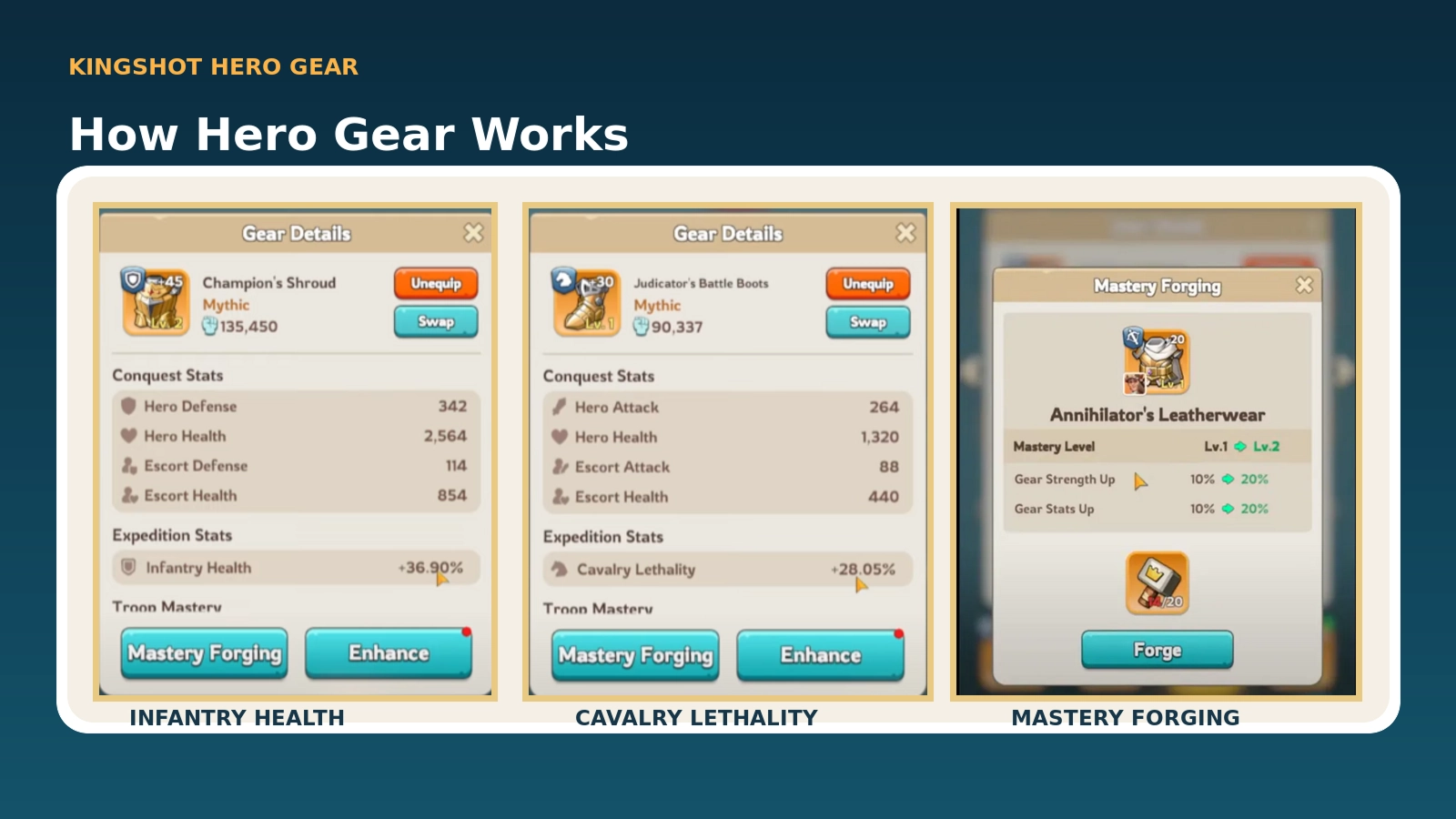
| Gear Quality | Color | Maximum Enhancement Level | Long-Term Role |
|---|---|---|---|
| Common | Gray | 20 | Early progression and Enhancement material |
| Uncommon | Green | 40 | Early progression and Enhancement material |
| Rare | Blue | 60 | Mid-game transition |
| Epic | Purple | 80 | Useful temporary gear before Mythic |
| Mythic | Gold | 100 | Main long-term Hero Gear investment |
| Legendary | Red | 100 after Ascension | Late-game Hero Gear progression |
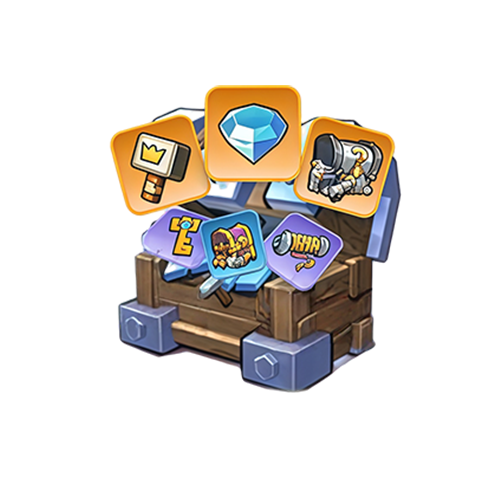
Two upgrade systems matter before late-game Legendary progression. Enhancement raises the normal level of a gear piece, while Mastery Forging is an additional progression layer for Mythic Hero Gear. Once your Town Center reaches Level 20, the Mastery Forging option becomes available and Forgehammers can be used on qualifying Mythic Gear. Forgehammers are typically a more restrictive resource than Enhancement XP for F2P and low-spending players, so choosing the right piece matters just as much as the number you spend.
Best Kingshot Hero Gear Upgrade Priority
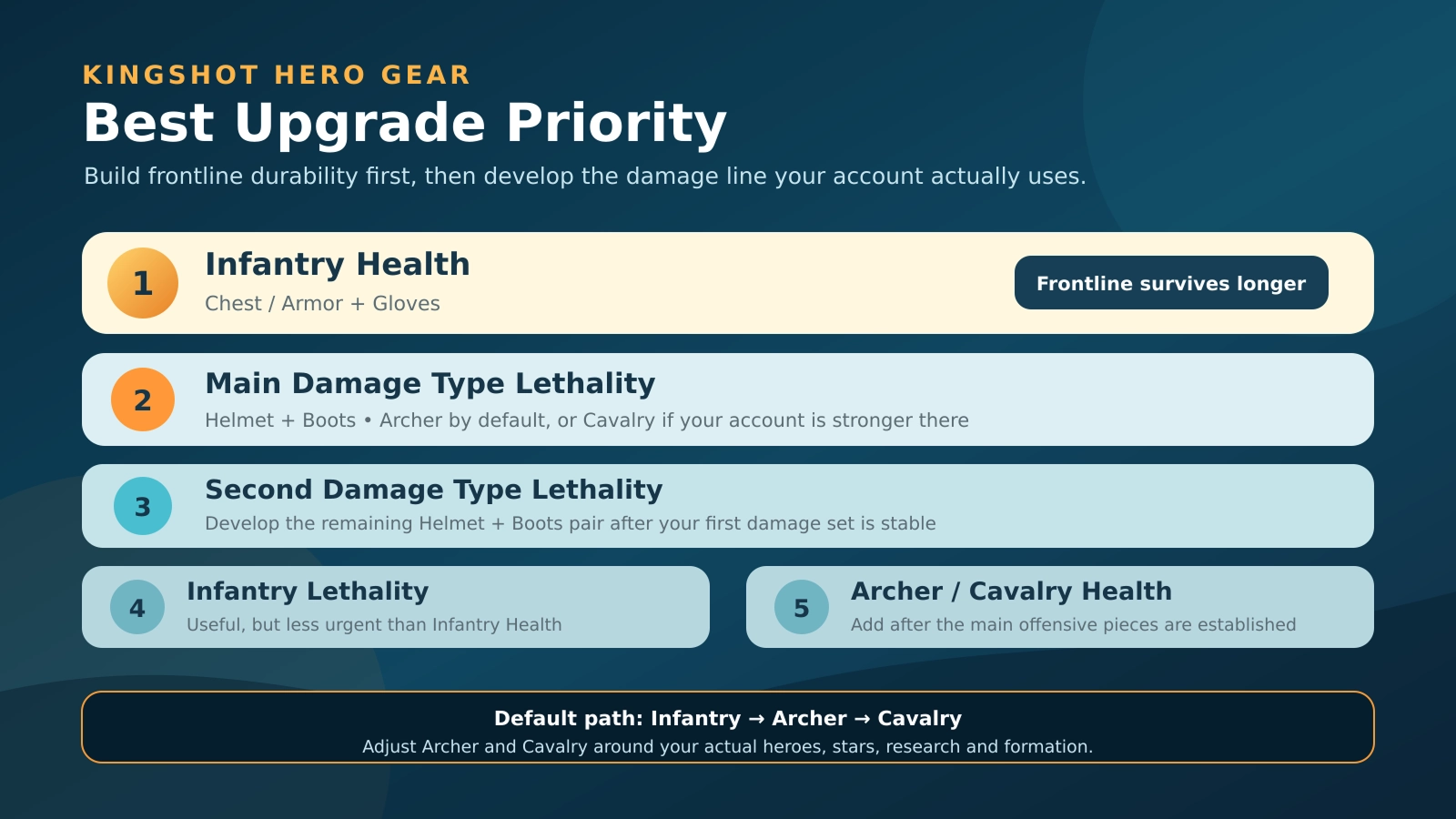
The strongest upgrade plan does not try to keep every piece at the same level. Instead, it puts the most valuable stats on the heroes that matter most to your main march. For a typical account, that means building enough Infantry durability to keep the frontline alive, then investing in the damage line that benefits most from additional Lethality.
| Priority | Gear Focus | Main Stat | Why It Comes Here |
|---|---|---|---|
| 1 | Infantry Armor and Gloves | Health | Keeps the frontline alive so the rest of the march has more time to deal damage |
| 2 | Strongest Damage Type Helmets and Boots | Lethality | Improves the troop type currently carrying most of your offensive output |
| 3 | Other Damage Type Helmets and Boots | Lethality | Adds another reliable source of damage after the primary line is developed |
| 4 | Infantry Helmets and Boots | Lethality | Useful offensive improvement, but normally less urgent than Infantry survival |
| 5 | Archer/Cavalry Armor and Gloves | Health | Improves survivability after the major offensive pieces are already established |
1. Infantry Health Usually Comes First
Infantry takes the frontline role, which makes survival the first problem many marches need to solve. If that frontline disappears too quickly, adding more damage to the back line may not produce the result you expect because those troops simply have less time to work. This is why the Health-focused Infantry pieces, Armor and Gloves, are usually the safest place to begin concentrating Enhancement XP and Forgehammers.
That does not mean you need to push one Infantry piece as far as possible while ignoring everything else. Build the two important Health pieces around useful progression points and keep the pair reasonably close. If one piece is already near its next major upgrade while the other is several stages behind, finishing the nearby upgrade first is fine, but repeatedly driving only one item far ahead can leave your investment unnecessarily uneven.
2. Upgrade the Damage Type Your Account Actually Uses
A common player recommendation puts Archer Lethality directly after Infantry Health, with Cavalry Lethality third. It is a useful starting point, not an official or universal order. Hero generation, star levels, Hero Exclusive Gear, research, and your existing investment can all change which troop type is doing the most useful work for your account.
If Archers are clearly your strongest damage line, their Helmets and Boots should receive the next serious investment. If your account is built around a stronger Cavalry march, move Cavalry Helmets and Boots ahead instead. Resources spent on a theoretically perfect priority are still inefficient if the heroes using that gear are much weaker than the alternative already available on your account.
3. Build the Second Damage Set After the First Is Stable
Once Infantry can survive reliably and your strongest offensive troop type has a solid Lethality setup, start developing the remaining damage set. This gives you six important pieces across the main Infantry, Archer, and Cavalry heroes without forcing resources into every slot at once. At this point, the march has both a durable frontline and two developed damage sources, which is a much better foundation than twelve similarly leveled pieces with no clear specialization.
Which Hero Gear Is Worth Investing In?
The best Hero Gear is not simply whichever item has the highest rarity visible on your account. What matters is whether that piece belongs to a long-term slot on your main march and whether the resources spent on it move you toward a useful breakpoint. Lower-rarity gear naturally becomes replaceable as Mythic pieces arrive, so expensive long-term investment should increasingly shift toward equipment that you expect to keep.
Mythic Hero Gear is the main long-term target because it supports both normal Enhancement and Mastery Forging and can later progress into Legendary Gear. That does not mean an undeveloped Mythic item instantly becomes better than a heavily upgraded Epic piece. If your Epic gear currently gives better combat stats, you can continue using it while directing new resources toward the Mythic replacement. The mistake is not using an Epic piece temporarily; the mistake is continuing to pour scarce resources into it after its Mythic replacement is ready to take over.
Enhancement XP vs. Forgehammers: Spend Them Differently
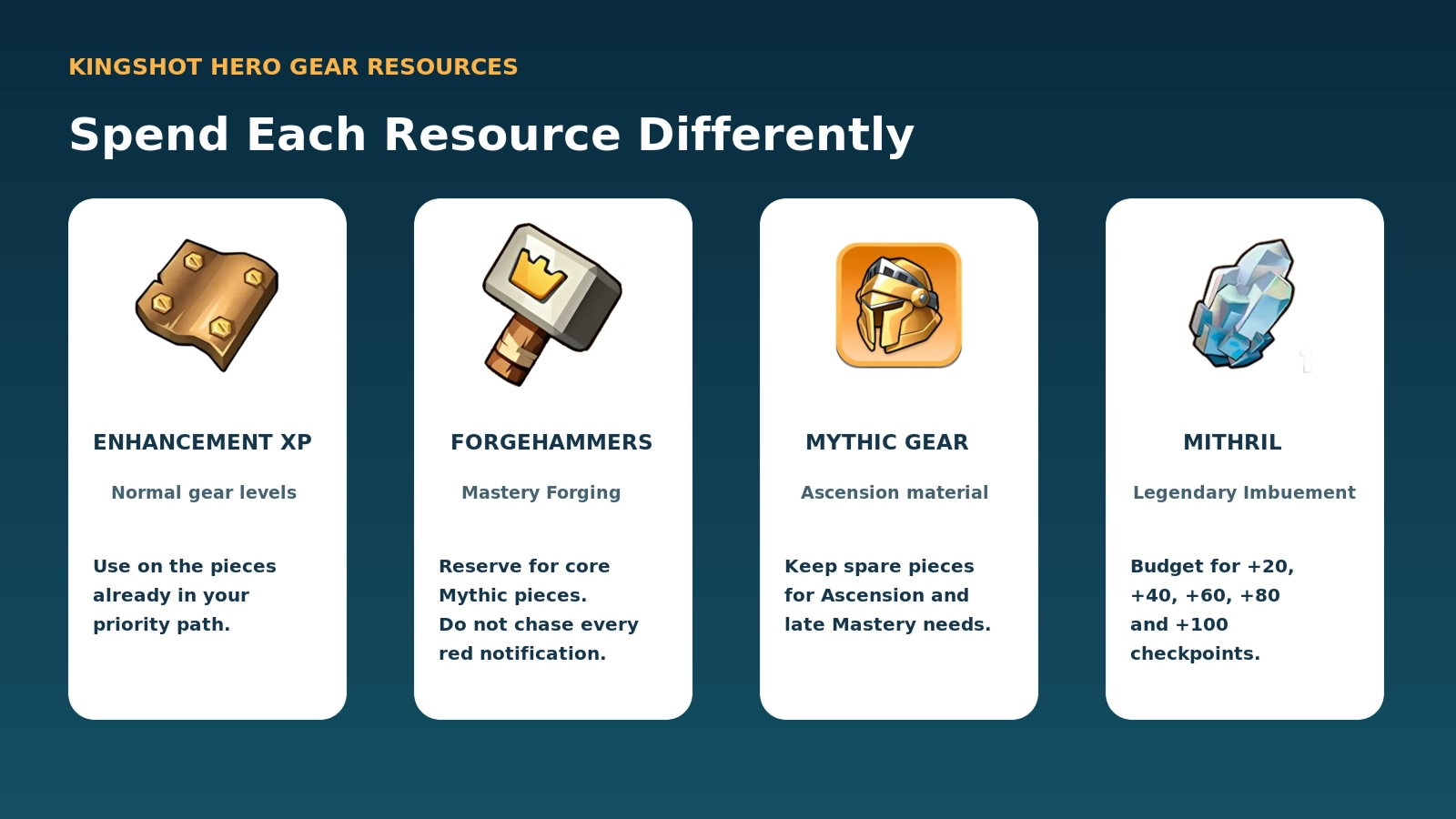
Enhancement XP and Forgehammers should not be treated as interchangeable upgrade resources. Enhancement XP is used to increase normal gear levels and is generally easier to redirect as your equipment changes. Forgehammers are used for Mastery Forging on Mythic Hero Gear, making careless Forgehammer spending much harder to recover from. When Mastery becomes available, the safest plan is to reserve those Forgehammers for the Mythic pieces already identified as part of your main upgrade path.
In practice, this means your Infantry Health pieces and primary Lethality pieces should receive serious Mastery investment before secondary equipment. The red dot is not an upgrade plan; it only means that an upgrade is available. Before using Forgehammers, ask whether that item will still matter when you reach your next Hero Gear stage.
How to Prepare for Legendary Hero Gear
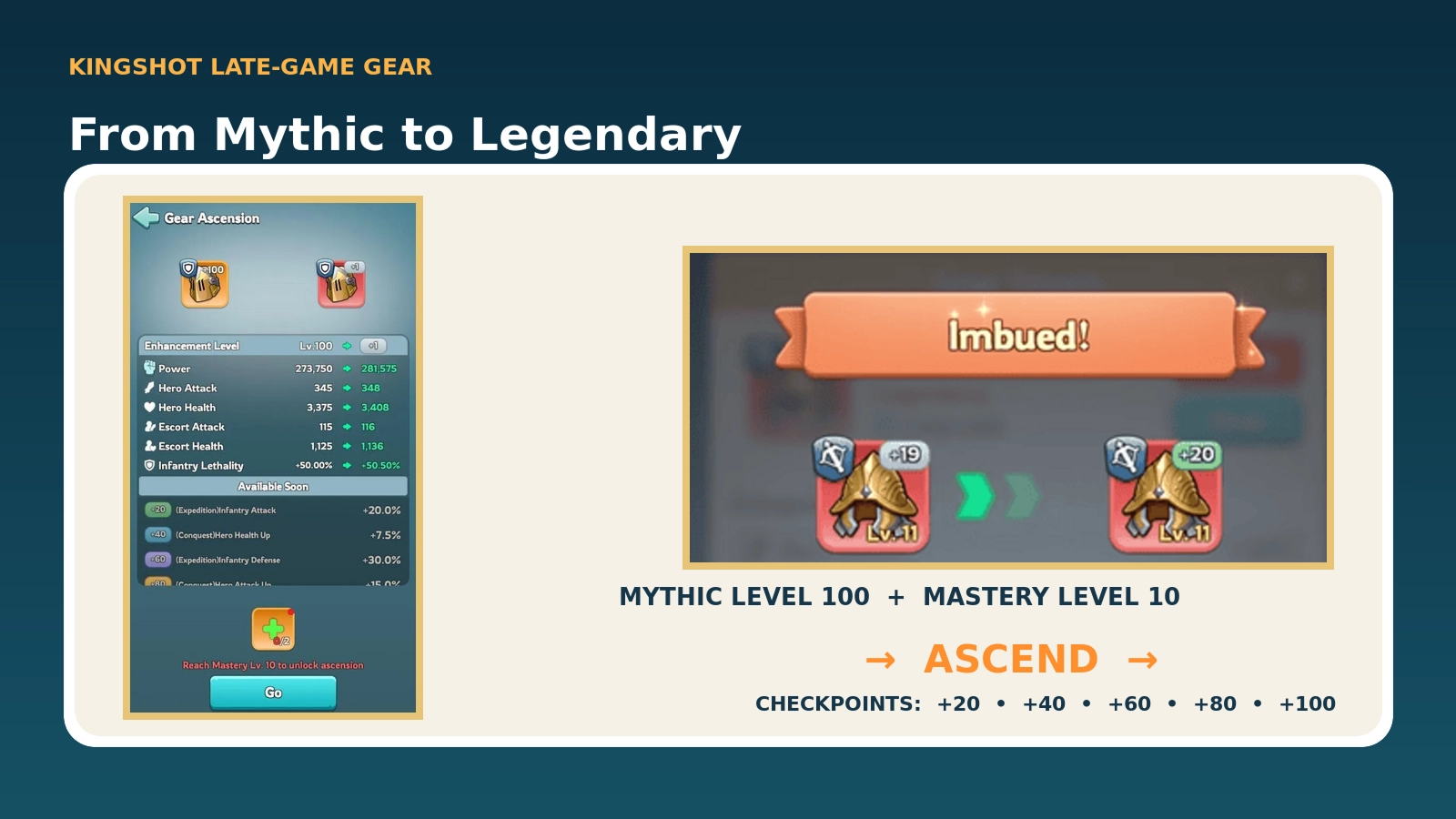
Late-game Hero Gear progression requires more planning than simply reaching another Enhancement level. Gear Ascension becomes available after the server has been active for the required period and the target Hero Gear reaches Enhancement Level 100 and Mastery Level 10. Ascension upgrades that Mythic Gear into Legendary Gear.
You should start preparing before a priority item actually reaches those requirements. Spare Mythic Gear becomes valuable for this process, and using every duplicate to build secondary heroes can create a material shortage later. If one of your core items is approaching Level 100 and Mastery 10, keep enough resources in reserve to finish that piece instead of bringing several different items close to the same milestone without completing any of them.
After Ascension, Legendary Gear can be enhanced further, with an official post-Ascension maximum of Enhancement Level 100. Gear Imbuement is required at Legendary Enhancement Levels 20, 40, 60, 80, and 100, using Mithril and the required Mythic Gear. Imbuement is a late-game system, but Mithril is scarce enough that it is worth stockpiling when reasonably priced opportunities appear. Saving Mithril does not replace the need for Enhancement XP, Forgehammers, and spare Mythic Gear.
How to Spend Hero Gear Resources Efficiently
The easiest way to manage Hero Gear is to separate your account into priorities instead of trying to improve everything whenever materials appear. Start with the three heroes that form your main Infantry, Archer, and Cavalry core. Give them functional gear first, then identify which six pieces solve the most important problems: Infantry Health plus the Lethality pieces for your two damage types.
From there, concentrate resources rather than constantly chasing visual balance. If Infantry is still dying too quickly, another Health improvement is usually more useful than raising a secondary Archer Health piece simply because it is several levels lower. Once the frontline becomes reliable, move that investment toward damage instead of continuing to stack Health without a clear reason. Your priority should change when the weakness of the march changes.
The same logic applies when you obtain a new hero. Do not automatically start a completely new Hero Gear project just because the hero is newer. Hero Gear can be moved to another hero of the same troop type, so check whether your existing Infantry, Cavalry, or Archer equipment can support the new main hero before starting over. If you are still deciding which heroes deserve long-term resources, the Kingshot Hero Tier List can help separate main-march investments from heroes that are more likely to remain secondary.
Common Kingshot Hero Gear Mistakes
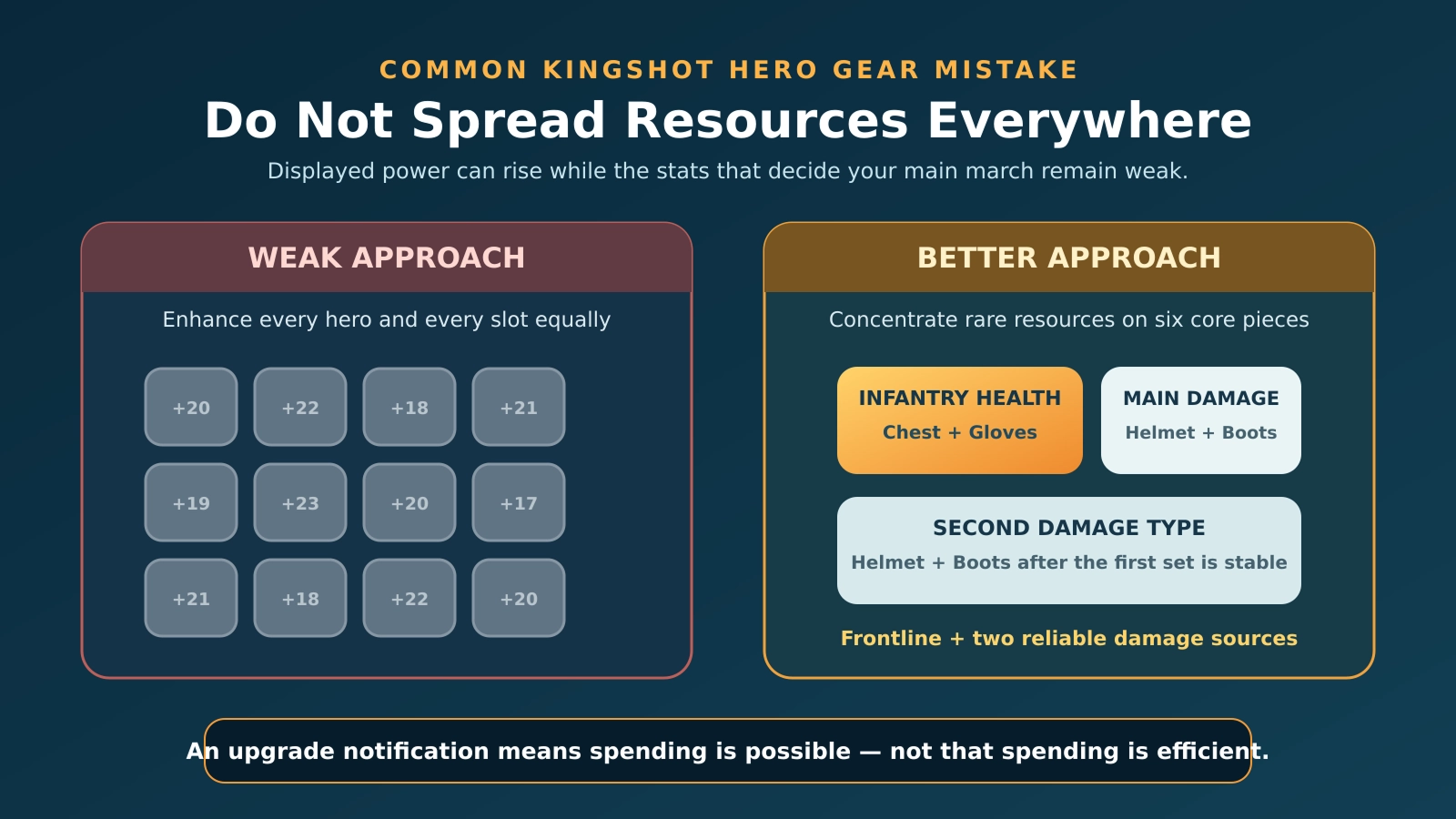
Upgrading Every Hero and Every Gear Piece Equally
This is the most expensive-looking way to gain very little practical improvement. Twelve moderately upgraded pieces across several heroes may increase displayed power, but they often leave the important frontline and damage stats weaker than an account that focused the same materials on a smaller set. Build the main march first, then expand into additional Arena or secondary heroes after the core gear is stable.
Finishing a Full Troop Set Before Touching Another Type
A full Infantry set may look satisfying, but not all Infantry stats solve the same problem. Spending heavily on Infantry offensive pieces while Archer or Cavalry Lethality remains neglected can slow the march's damage development. Focus first on the high-value stats across your three troop types, then return to the remaining slots once those priorities are established.
Following Archer Second Without Looking at Your Heroes
Archer Lethality is a common second priority among players, but accounts are not identical. A player with a much stronger Cavalry lineup may gain more immediate value by developing Cavalry Helmets and Boots first. Use the common order as a starting point, then adjust it around the heroes, stars, research, Hero Exclusive Gear, and formations that are actually carrying your battles.
Spending Forgehammers on Temporary Gear
Enhancement XP is easier to replace than deep Mastery investment, so Forgehammers deserve more discipline. Avoid using them simply because a Mythic item can be forged. Decide first whether the piece belongs to your long-term main-march setup. A few unnecessary upgrades may not feel expensive on their own, but repeated Forgehammer spending across secondary gear can delay Mastery 10 on the item you actually want to Ascend.
Overinvesting in Epic Gear After Mythic Is Available
An upgraded Epic piece does not need to be thrown away the moment a Mythic replacement appears. Use whichever item currently gives you the better result while preparing the new piece. What you should avoid is continuing to sink major resources into Epic gear when the corresponding Mythic equipment is already available and clearly becoming the long-term replacement.
Using Every Spare Mythic Piece on Secondary Heroes
Extra Mythic Gear becomes increasingly important once Ascension and Imbuement enter your progression. Building another complete secondary set may feel productive, but doing so at the wrong time can leave your best item waiting for materials when it reaches its Legendary requirement. Before assigning duplicate Mythic pieces elsewhere, check whether one of your six core items is approaching a major upgrade.
Upgrading Because the Game Shows a Notification
An available upgrade is not automatically a good upgrade. Notifications do not know which troop type carries your damage, which gear you plan to replace, or which material you are saving for Ascension. Treat them as reminders that spending is possible, not instructions that spending is efficient.
Hero Gear Priority for F2P and Low-Spending Players
Players with limited materials benefit the most from specialization because every unnecessary upgrade delays a more important one. Build usable sets for the main three troop types, then direct the rarest resources toward Infantry durability and your strongest damage pieces. Secondary Health and Lethality slots can wait until the core gear reaches a level where another upgrade would be disproportionately expensive.
Forgehammers in particular should stay concentrated. If you mainly join alliance rallies rather than start them, there is even less reason to spread deep Mastery investment across several heroes. Hero Gear still matters when you lead your own marches and in Arena, but your spending should match the content you actually play rather than copying the equipment levels of a dedicated Rally Captain.
Spending can accelerate access to materials, but it does not fix a poor upgrade order. If you decide to buy Kingshot packs for progression resources, compare the pack contents against the material currently blocking your priority piece rather than purchasing only because a pack contains Hero Gear items. The Kingshot top-up page can be used when you already know which in-game pack fits the upgrade you are planning.
Kingshot Hero Gear FAQ
What Hero Gear should I upgrade first in Kingshot?
For most players, Infantry Health gear should come first, especially the Health-focused Armor and Gloves. After the frontline is stable, invest in the Helmets and Boots of your strongest damage type. Archer is a common player default, but Cavalry can move ahead when your account is clearly stronger there.
Should I upgrade all Hero Gear evenly?
No. Keeping every Hero Gear piece at the same level spreads Enhancement XP and Forgehammers across lower-impact stats. Concentrating resources on the main three heroes and their most important pieces normally creates a stronger march before you begin developing secondary slots.
When should I start using Forgehammers?
Mastery Forging becomes available once your Town Center reaches Level 20 and you have qualifying Mythic Hero Gear. Because Forgehammers are a valuable long-term resource, use them mainly on Mythic pieces that already belong to your planned main-march setup.
What do I need before Ascending Hero Gear?
The target Hero Gear needs to reach Enhancement Level 100 and Mastery Level 10, and Gear Ascension also depends on the server having been active for the required period. Plan ahead by saving the Mythic Gear and other resources needed for the Legendary progression path rather than waiting until the item is already finished.
Is Mythic Gear always better than upgraded Epic Gear?
Not immediately. A heavily enhanced Epic piece can remain stronger than a newly obtained Mythic item until the Mythic replacement receives enough investment. Keep using the stronger current option, but shift new long-term resources toward the Mythic piece instead of continuing to overbuild gear you know will eventually be replaced.