

Linko is an S-Rank Anima damage character in Neverness to Everness who combines burst damage, follow-up attacks, and team-driven Synced Strikes. Rather than staying on field for an entire rotation, she can build Modulation through her own attacks, call teammates into coordinated attacks with Full-Frequency Pulse, then turn Oversync into a larger burst window where several characters can contribute damage. Her kit also supports off-field play through Xiaozhen, making Linko especially comfortable as a sub-DPS who can keep contributing while another character handles the main field time. If you are preparing resources for her, the Neverness to Everness top-up page is available alongside the rest of BuffHub's NTE coverage.



Linko's Level 80 statline supports an offensive ATK-and-CRIT build rather than defensive scaling. Her Type III Console specialization makes CRIT management especially important, while her signature Plasma Arc supplies even more CRIT Rate. Because several parts of the build can provide the same stat, players should check their finished setup instead of automatically stacking CRIT Rate on every available slot.









Linko is part of the NTE 1.3 character lineup, so players deciding where to spend pulls can also compare her availability with the current NTE 1.3 banner schedule. Her value is easiest to see on accounts that already have a main DPS capable of taking advantage of repeated Synced Strikes, follow-up attacks, or reaction-based teams.
Terminology note: this guide uses the established English names available for Linko's main skills, Arcs, Cartridges, and Awakenings. Some smaller marks and combat effects in the NTE 1.3 data do not yet have a clear English label, so they are described by their function instead of being given an invented name.
Who Is Linko and What Is Her Playstyle?
Linko is best understood as a burst-oriented sub-DPS and follow-up attack enabler. Her own damage matters, especially through Spectral Cross and Oversync, but a large part of her kit is designed around choosing another attacker and turning that character's attack into a Synced Strike. Full-Frequency Pulse even pauses the timer briefly while the player selects who should attack, so the mechanic is not simply a passive follow-up that happens without input.
Her Basic Attack builds Modulation points, while Full-Frequency Pulse consumes those points to strengthen the Synced Strike it triggers. The selected attacker can be one of Linko's teammates or Xiaozhen, and the resulting coordinated hit receives its own damage increase before gaining another bonus from the Modulation that was consumed. Because Linko decides who performs the attack, the Redirect Skill can be used to support whichever teammate currently offers the most valuable damage type or burst opportunity.
This becomes even more important because of Precision Tuning. Whenever a Synced Strike is triggered, the enemy loses 8% Esper Resistance matching the damage type of the character who performed that Synced Strike for 12 seconds. Different resistance reductions can exist on the target at the same time, while repeatedly applying the same type refreshes its duration instead of stacking it. Linko therefore becomes particularly useful in teams that want more than one character to contribute meaningful damage rather than putting every resource into a single attacker.
Her other major identity is follow-up damage. Weakness Radar strengthens the follow-up-attack bonus associated with Linko's marked effect to 30%, while targets affected by that mark take 10% increased follow-up attack damage. Oversync pushes this theme even further because Support Skills triggered inside its lingering field are treated as Synced Strikes and also count as follow-up attack damage.
- Primary role: Burst-oriented sub-DPS with strong Synced Strike and follow-up attack interaction.
- Best Arc: Voice of the Voyager for Support Skill and Ultimate-focused damage.
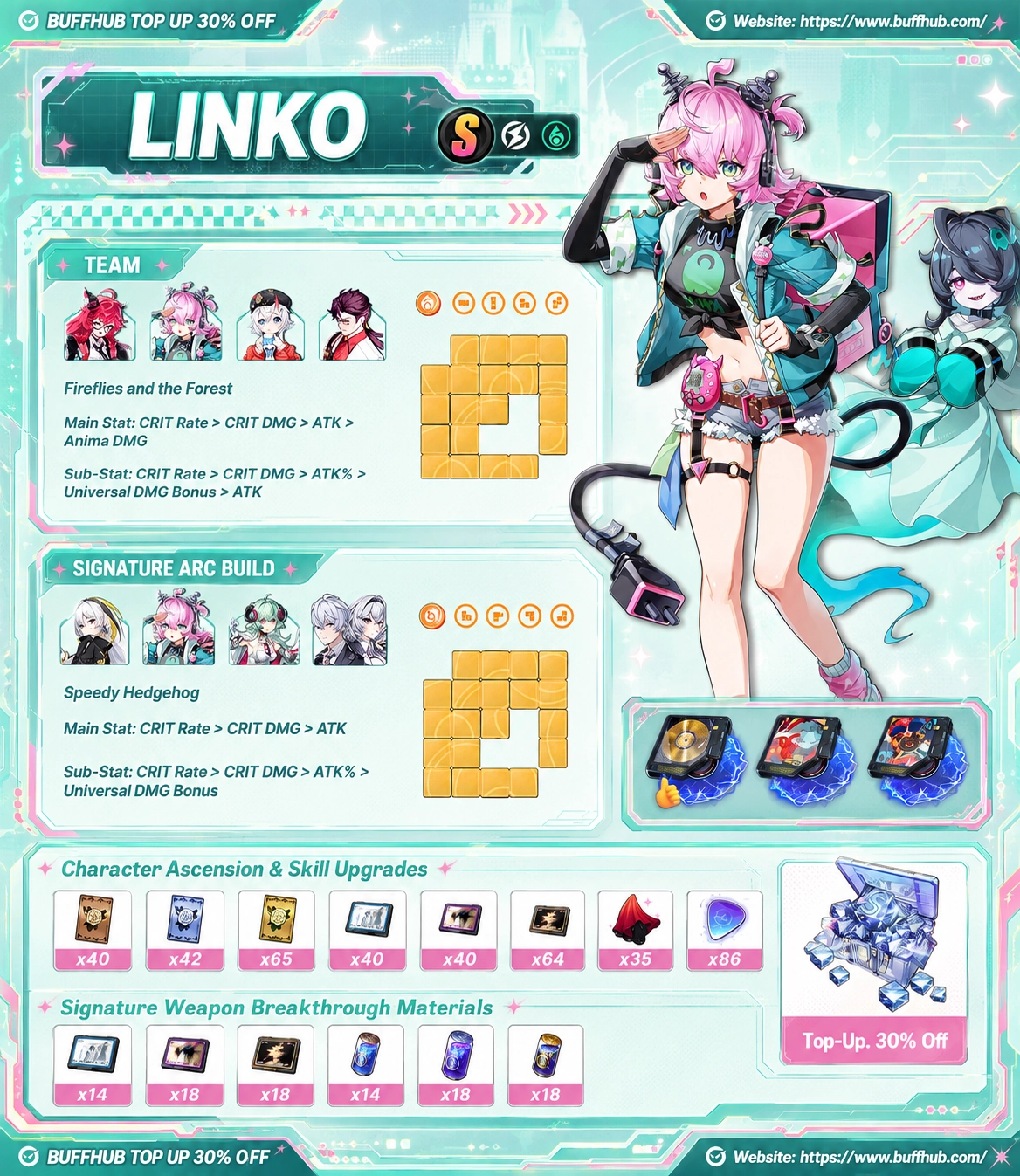
- Best personal-damage Cartridge: Fireflies and the Forest.
- Skill priority: Support Skill > Ultimate > Basic Attack > Redirect Skill.
- Stat focus: Build enough CRIT Rate first, then shift investment toward CRIT DMG and ATK.
How Do Linko's Skills Work?
Basic Attack: Poltergeist CQC
Poltergeist CQC performs up to five consecutive attacks dealing Anima DMG. Each successful hit builds Modulation, giving Linko a reason to spend some field time attacking before using Full-Frequency Pulse rather than immediately casting her Redirect Skill with no setup. At Skill Level 10, the individual combo stages range from a 99.2% first hit to a 147.9% fifth hit, with the fourth sequence containing several separate hits.
Holding Basic Attack during the early part of the combo triggers Spectral Smack, a heavier attack with a listed 199.9% Level 10 multiplier. Linko can also use Spectral Entrance while airborne, dealing area damage after landing; the attack becomes stronger with greater fall height and can gain up to double the normal damage from that height scaling. These attacks help her function when she needs to remain on field, but they are not the main reason to build her.
The more important part for a sub-DPS setup is Spectral Rush. While Linko is off field, Xiaozhen attacks the target once every 8 seconds and applies a special mark. Breaking that mark is one of the methods Linko can use to call a teammate into a Synced Strike, which means her off-field contribution is tied directly back into the central coordinated-attack mechanic rather than existing as isolated passive damage.
After a Critical Dodge, Linko can also perform a counterattack that deals four instances of area Anima DMG while building Modulation. Its Level 10 ratio is 51% × 3 + 242.9%. The counter is useful because it lets her regain some of the resource needed for stronger Synced Strikes without abandoning the normal defensive rhythm of combat.
Redirect Skill: Full-Frequency Pulse
Full-Frequency Pulse is the skill that ties Linko's entire kit together. She fires ghostly energy at the enemy for up to four instances of Anima DMG, then calls either Xiaozhen or one teammate to perform a Synced Strike. A selection wheel appears during this sequence, and time briefly pauses while the player chooses who should attack.
The selected Synced Strike receives a damage increase, then gains additional damage based on the Modulation points Linko consumed. That makes Modulation more than a resource for Linko's personal attack; it is a way to amplify the teammate she brings into the action. The Level 10 damage of Full-Frequency Pulse itself is 35.6% + 27.6% + 47.6% + 89.2%, so the Redirect Skill's larger value comes from the coordinated hit and the effects attached to that hit rather than from its own multiplier.
If a teammate is unavailable or not included in the party, Xiaozhen fills that position on the wheel. Each additional Xiaozhen occupying one of those slots further increases the damage bonus of Xiaozhen's Synced Strike. This gives the mechanic a fallback even when the team cannot supply three valid attackers, although normal team compositions will usually want Linko calling real teammates whenever their skills and damage types offer stronger synergy.
Support Skill: Spectral Cross
Spectral Cross has an unusually important role in Linko's build because the damage of her Synced Strikes scales with its skill level. The Support Skill itself deals one area hit of Anima DMG with a 399.8% Level 10 multiplier, but Linko's listed Synced Strike reaches 999.5%. Xiaozhen's version deals 66.6% × 3 + 199.9%.
Linko can call teammates into Synced Strikes in three listed ways: by breaking Xiaozhen's off-field mark, casting Full-Frequency Pulse, or using Oversync. This is why Spectral Cross is not just a secondary skill that is occasionally triggered from the back line. Raising it directly improves one of the mechanics that Linko repeatedly uses across both her normal rotation and Ultimate window.
Ultimate: Oversync
Oversync costs 100 Ultimate Energy and places Linko into an overloaded state while creating a field around the fight. During this period, she can synchronize with up to three teammates. Pressing the Redirect Skill calls those teammates one after another to perform Synced Strikes, with a maximum of three coordinated attacks during the active sequence.
When the overloaded state ends, either naturally or because Oversync is pressed again to end it early, Linko releases a final noise burst across the field. At Skill Level 10, the listed damage includes 115.1% × 6 multi-hit Anima damage followed by an extremely large 1469.9% Anima Burst DMG hit. That final burst becomes stronger according to the number of different negative-effect types already present on the target, so Linko benefits from teams that can establish several debuffs before the finisher lands.
The field does not disappear immediately when the overloaded state ends. During its remaining duration, team Support Skills used inside the field count as Synced Strikes and are treated as follow-up attack damage. They also gain the effects associated with Precision Tuning and several of Linko's later Awakenings, turning the period after the initial Ultimate sequence into another opportunity to continue coordinated attacks.
This is the main reason her Ultimate should not be treated like a single burst button. The 1469.9% finisher is impressive, but much of Oversync's actual value comes from fitting several Synced Strikes and Support Skills around it. Ending the state early can give faster access to the final hit when necessary, but doing so without using the available coordinated attacks leaves a large part of Linko's kit unused.
Weakness Radar and Precision Tuning
Weakness Radar reinforces Linko's follow-up role by improving the follow-up-attack bonus associated with her mark to 30%. Enemies affected by that mark also take 10% more follow-up attack damage. This works naturally with teams where follow-up attacks already represent a meaningful share of the total damage rather than being a minor extra hit.
Precision Tuning is the more universal passive. Every Synced Strike reduces the target's resistance to the attacker's corresponding damage type by 8% for 12 seconds. Because different types can coexist, Linko can support mixed-damage teams without forcing every character to share Anima with her, while repeated applications of the same type can keep one resistance reduction active through an extended damage window.
Best Linko Rotation
Linko's rotation is less about memorizing a single fixed combo and more about preparing a strong Synced Strike and Oversync window. Modulation should be built before Full-Frequency Pulse when Linko has time to attack, while Xiaozhen's off-field strike continues creating opportunities for coordinated attacks when another character is occupying the field. The most efficient sequence is the one that sends the right teammate into each Synced Strike instead of simply using whichever option appears first.
- Use Poltergeist CQC while Linko is active to build Modulation.
- Take advantage of Xiaozhen's Spectral Rush while Linko is off field and watch for its mark.
- Cast Full-Frequency Pulse after building Modulation, then select the teammate whose Synced Strike is most valuable for the current damage window.
- Use Synced Strikes to maintain the appropriate 8% resistance reduction from Precision Tuning.
- Enter Oversync when the team is ready to contribute coordinated attacks and the target already has useful negative effects.
- Call up to three teammates during Oversync, then continue triggering Support Skills while the field remains active.
- Allow the Ultimate to reach its final burst, or end it manually when the 1469.9% Anima Burst DMG needs to be delivered immediately.
The most common resource mistake with Linko is treating Full-Frequency Pulse as an ordinary damage Skill and spending it with little Modulation or no useful teammate ready to attack. Her Redirect Skill is considerably more valuable when the Synced Strike it calls also lines up with Precision Tuning, follow-up amplification, and the next team damage window. The same logic applies to Oversync: three coordinated attacks plus the lingering field are part of the Ultimate, not extra effects that can be ignored while waiting for the final explosion.
What Is the Best Arc for Linko?

Linko uses Plasma Arcs, and her signature Voice of the Voyager is the strongest option for the Support Skill and Ultimate-focused build. At Level 80, it provides 570 ATK and 24% CRIT Rate, then adds another 24% ATK through its R1 passive. Those stats already fit an ATK-scaling attacker whose Console encourages building around CRIT.
The more important part of Voice of the Voyager is its direct interaction with Linko's primary damage sources. It increases Support Skill CRIT DMG by 66%, and every Support Skill hit increases Ultimate CRIT DMG by 22% for 3 seconds, stacking up to three times. At maximum stacks, that represents up to 66% additional Ultimate CRIT DMG, and repeated triggers refresh the duration.
| Arc | Rarity | Level 80 Stats | Why Use It? |
|---|---|---|---|
| Voice of the Voyager | S-Rank | 570 ATK, 24% CRIT Rate | Best-in-slot for Linko's core build. Adds 24% ATK, 66% Support Skill CRIT DMG, and up to three stacks of 22% Ultimate CRIT DMG after Support Skill damage. |
| Fluff of Fortitude | S-Rank | 512 ATK, 27.5% ATK | Strong general damage option. Grants 22% DMG, increasing to 28% against enemies below 50% HP. Better suited to a more active on-field Linko than the signature-focused Support Skill and Ultimate setup. |
| Oraora! | A-Rank | 395 ATK, 37.5% ATK | Best supplied A-Rank alternative. Each Basic Attack increases Basic Attack DMG by 2% for 10 seconds, stacking up to 10 times, making it mainly an on-field Basic Attack option. |
Fluff of Fortitude is the most attractive S-Rank substitute when you want Linko to spend more time actively attacking. Its 27.5% ATK stat is useful across her kit, while its passive gives 22% increased damage and raises that bonus to 28% against targets below half HP. Her Basic Attack and Full-Frequency Pulse benefit more from this general damage profile than from the signature's specialized Support Skill and Ultimate bonuses.
The tradeoff is that Linko's strongest build is not centered on Basic Attack and Redirect Skill damage. Her Support Skill scaling controls her Synced Strike damage, while Oversync contains her largest burst multiplier. Fluff of Fortitude therefore remains a good Arc rather than a true replacement for Voice of the Voyager when the goal is to maximize the parts of her kit that define her normal sub-DPS role.
Oraora! is the strongest supplied A-Rank fallback. Its lower 395 base ATK is partially compensated by a large 37.5% ATK stat, and every Basic Attack grants 2% Basic Attack DMG for 10 seconds, up to ten stacks. It can support a more field-heavy Linko, but it provides no CRIT stat and does nothing directly for Spectral Cross or Oversync, so the parts of her kit with the highest supplied multipliers lose more damage than they do with her signature.
Which Cartridge and Stats Are Best for Linko?

Fireflies and the Forest
Fireflies and the Forest is Linko's best supplied Cartridge for personal damage. Its Epic 2-piece effect gives 10% Anima DMG, directly matching her own damage type. The Legendary 4-piece effect increases the wearer's CRIT DMG by 8% whenever a nearby enemy takes Anima DMG from the team, stacking up to seven times for 10 seconds.
At seven stacks, the set can supply a large amount of CRIT DMG without forcing Linko to remain active. The effect explicitly stays active while the wearer is off field, and Linko can continue contributing Anima damage through Xiaozhen's Spectral Rush. Anima teammates also make the trigger easy to maintain, so the Cartridge naturally fits the same teams where Linko is used as a sub-DPS rather than a permanent on-field attacker.
Speedy Hedgehog
Speedy Hedgehog is the other recommended Cartridge direction when Linko is being built for a more supportive role. Fireflies and the Forest is the clearer choice when personal damage is the priority, especially because both its Anima DMG and stacking CRIT DMG directly improve her own attacks. Speedy Hedgehog is better viewed as the role-based alternative when the goal is to push more of Linko's value toward supporting the rest of the team instead of maximizing her personal output.
Linko Stat Priority
The supplied main-stat order is CRIT Rate > CRIT DMG > ATK > Anima DMG, while the substat priority is CRIT Rate > CRIT DMG > ATK% > Universal DMG Bonus > ATK. In practice, CRIT Rate should only remain the first priority until Linko can reliably approach the 100% cap. Building beyond that point gives no additional value.
This is where her Console and signature Arc can change the build quickly. Every Type III Module gives 8% CRIT Rate, while Voice of the Voyager supplies another large CRIT Rate stat. Accounts using several Type III Modules together with the signature may therefore need much less CRIT Rate from the Cartridge main stat and substats than an account using Oraora! or another non-CRIT Arc.
| Build Area | Priority |
|---|---|
| Cartridge | Fireflies and the Forest 4-piece for personal damage; Speedy Hedgehog for a more supportive setup |
| Main Stats | CRIT Rate > CRIT DMG > ATK > Anima DMG |
| Substats | CRIT Rate > CRIT DMG > ATK% > Universal DMG Bonus > ATK |
| Console Bonus | 8% CRIT Rate for every Type III Module |
Players using Voice of the Voyager should check their actual CRIT Rate before automatically choosing more CRIT on every possible slot. Once enough CRIT Rate is already present, CRIT DMG and ATK become much more efficient ways to improve Spectral Cross, Synced Strikes, and Oversync. A non-signature build has the opposite problem: the extra ATK from Fluff of Fortitude or Oraora! is useful, but Linko must find more of her CRIT Rate through the Console and Cartridge stats.
What Is Linko's Skill Priority?
The recommended combat skill priority is Support Skill > Ultimate > Basic Attack > Redirect Skill. Spectral Cross comes first because Linko's Synced Strikes scale from its level, so raising the Support Skill improves far more than the single 399.8% hit shown on the skill itself. Since coordinated attacks are triggered through several parts of her kit, this investment keeps paying off across the whole rotation.
Oversync should be the second priority. Its Level 10 finisher reaches 1469.9% Anima Burst DMG before accounting for the additional multi-hit portion, and the Ultimate creates the window where several Synced Strikes can be chained together. Poltergeist CQC comes next because it improves both Linko's active attacks and the off-field damage tied to her Basic Attack skill set.
Full-Frequency Pulse is last, not because it is unimportant to the rotation, but because its own listed damage is not the main reason it is used. Its job is to consume Modulation, select a Synced Strike attacker, and connect Linko's other mechanics. Players upgrading gradually should therefore avoid maxing the Redirect Skill first just because it is pressed frequently.
What Are the Best Team Comps for Linko?

Team 1: Nanally + Linko + Sakiri + Adler
The first supplied composition is Nanally + Linko + Sakiri + Adler, a Hexed reaction team with Nanally as the main DPS and Linko working as the sub-DPS. Nanally already has a strong follow-up identity: while Ichi-daime's Authority is active, Fair Duel can trigger a follow-up whenever an ally deals Esper Cycle damage, and her Ultimate summons Underboss to coordinate attacks with her. Linko's follow-up amplification therefore supports a damage type that Nanally is already producing rather than forcing the main DPS into a new playstyle.
Linko also contributes off field while Nanally occupies the battlefield. Xiaozhen attacks every eight seconds, while Full-Frequency Pulse and Oversync can call Nanally into Synced Strikes when Linko takes over for a short window. Precision Tuning then lowers the target's Anima resistance by 8% when an Anima attacker performs the Synced Strike, helping both characters continue dealing damage after the coordinated attack itself has ended.
Sakiri contributes the offensive support side of the composition. Her Ultimate grants all teammates other than herself an ATK bonus equal to 30% of her Base ATK for 20 seconds, while Impish Trick reduces enemy DEF by 10% for 20 seconds after she inflicts Airborne or Suppress. Along with Adler, she supplies the Incantation side needed by the recommended Hexed setup.
Adler completes the lineup with survivability. Evil's Bane grants the active character a Blessing shield while also dealing Incantation damage over time, letting Nanally stay aggressive without asking Linko to give up one of the team's damage-oriented slots for a pure healer. The supplied team concept specifically uses both Adler and Sakiri to enable Hexed reactions, while Linko strengthens the follow-up damage that Nanally can repeatedly generate.
Team 2: Hathor + Linko + Iroi + Zero
The second supplied team is Hathor + Linko + Iroi + Zero. This is a Charge reaction composition where Linko supplies resistance reduction and helps the team produce Blossom more frequently. It is a more mixed-damage lineup than the Nanally team, which makes Precision Tuning especially valuable because Linko can reduce different types of Esper Resistance depending on which teammate she chooses for each Synced Strike.
Hathor provides the main burst pressure. Rider Express deals a large area hit before placing her into Emergency Delivery for five seconds, where Express Delivery Power converts into additional ATK and Aerial Command becomes Cyclone Strike. Calling Hathor for a Synced Strike lets Linko apply the matching 8% resistance reduction before Hathor commits to one of these short burst windows.
Iroi gives the lineup both healing and offensive support. Future Self Continuity heals the full team while providing an ATK bonus equal to 20% of Iroi's Base ATK for 20 seconds, and Sympathetic Nerves grants all teammates an additional 5% DEF Ignore for 20 seconds whenever she heals. Her Support Skill also heals the team, making her particularly comfortable in a Linko composition where Support Skills can gain extra value inside Oversync's field.
Zero adds another burst source through Cosmos damage. Divide by Zero already receives a 25% damage increase from Anomaly Perception, so Linko can choose Zero for a Synced Strike when the team wants Cosmos resistance reduction before his Ultimate rather than always selecting the same attacker. The resulting composition uses Linko less as a simple Anima buffer and more as a coordinator who can prepare different teammates for their own short damage windows.
- Choose Nanally + Linko + Sakiri + Adler if you want the clearer follow-up and Hexed setup, with Nanally taking the main on-field DPS role.
- Choose Hathor + Linko + Iroi + Zero if you prefer mixed-damage burst, Charge reactions, healing support, and more frequent use of Linko's multi-element resistance reduction.
What Materials Are Needed to Upgrade Linko?
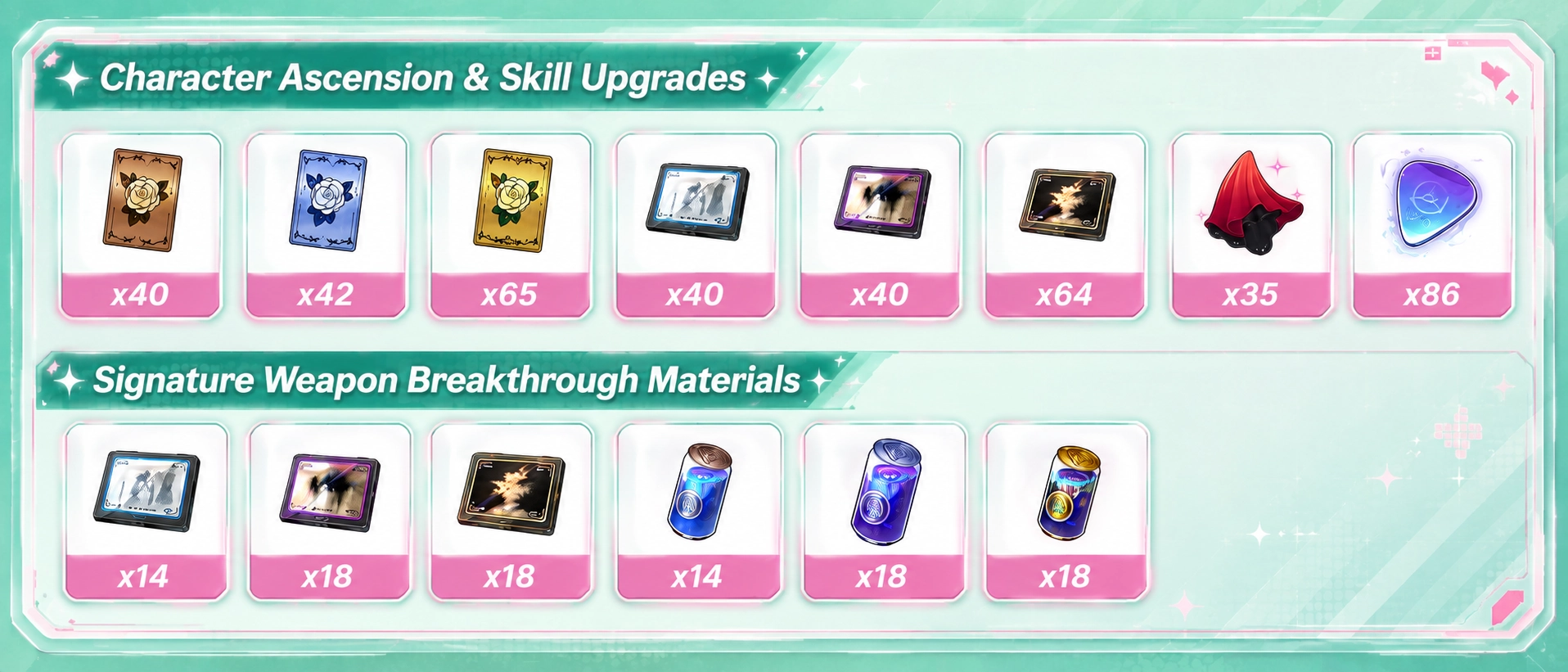
Raising Linko from Level 1 to Level 80 requires Beetle Coins, three tiers of Silhouette materials, and Water Moon Pick. Her supplied combat-skill totals correspond to raising the listed skills to 10 / 10 / 10 / 10 / 5 / 2, requiring a much larger Beetle Coin investment alongside Dreamless Seed, Fons, FNG, CO, White Rose, and Dress Hem of Vanity. Players preparing for the version can also check the current NTE codes page separately for any available redeemable rewards.
| Upgrade | Material | Amount |
|---|---|---|
| Character Level | Beetle Coin | 525,000 |
| Character Level | Fading Silhouette | 17 |
| Character Level | Blurred Silhouette | 18 |
| Character Level | Chaos Silhouette | 15 |
| Character Level | Water Moon Pick | 86 |
| Skills | Dreamless Seed | 96 |
| Skills | Fons | 38,400 |
| Skills | Beetle Coin | 1,818,000 |
| Skills | Fading Silhouette | 40 |
| Skills | Blurred Silhouette | 40 |
| Skills | Chaos Silhouette | 64 |
| Skills | FNG | 40 |
| Skills | CO | 42 |
| Skills | White Rose | 65 |
| Skills | Dress Hem of Vanity | 35 |
If materials are limited, the listed skill priority gives a clear way to avoid spending everything at once. Spectral Cross should receive the first major investment because it also controls Synced Strike scaling, followed by Oversync. Poltergeist CQC and Full-Frequency Pulse can be finished afterward, with the Redirect Skill placed last despite its importance to the rotation.
Which Linko Awakenings Are Worth Using?
Linko's Awakenings do not all improve the same part of her kit. Some increase her personal burst, others make Synced Strikes more frequent or more powerful, and several strengthen the entire team's coordinated attacks. Because Awakening choices can be switched to suit a particular encounter, it makes more sense to judge them by role than to assume one fixed setup is correct for every team.
| Awakening | Effect | Practical Value |
|---|---|---|
| All Frequencies Live | Reduces the interval of off-field Spectral Rush by 25%. | Useful for more consistent off-field contribution and more frequent access to Xiaozhen's mark. |
| Friendly Haunting | Increases Oversync's Anima Burst DMG multiplier by 15%. | A straightforward personal burst upgrade focused on Linko's largest Ultimate hit. |
| Across the Airwaves | Casting Oversync refreshes the cooldown of Full-Frequency Pulse. | Strong rotation utility because the Ultimate immediately prepares another Redirect Skill and Synced Strike. |
| Starlit Whispers | Each Synced Strike inside the field deals an additional 100% AoE Anima DMG. The attack can consume Xiaozhen's mark and trigger a Synced Strike. | One of the most directly synergistic damage upgrades for the core Oversync and follow-up playstyle. |
| Love, Loud and Clear | Synced Strikes triggered by Full-Frequency Pulse can trigger the corresponding Cycle effect. If Linko and the selected teammate cannot create that effect, the Synced Strike gains 20% increased damage. | Flexible team upgrade that rewards compatible pairings without leaving incompatible attackers completely unsupported. |
| The World Answers | While Linko is in the team, Synced Strikes gain 25% CRIT Rate, and teammate Synced Strikes can gain a charging effect. | Powerful teamwide Synced Strike scaling, particularly valuable when several characters contribute coordinated attacks. |
| Shared Pulse | Resonance Lv.3: raises Spectral Cross, Full-Frequency Pulse, and Oversync by 1 level and increases Linko's ATK by 10%. | Broad direct upgrade to all three major parts of her combat kit. |
| Perfect Reception | Resonance Lv.6: extends the field duration by 5 seconds and grants the team 12% Anima and Incantation DMG during it. | High-investment team upgrade with extra time for Support Skills and Synced Strikes, especially strong in Anima and Incantation lineups. |
For pure personal damage, Starlit Whispers and Friendly Haunting are the clearest offensive choices from their listed effects. Friendly Haunting directly raises the huge burst portion of Oversync, while Starlit Whispers adds another AoE Anima hit every time a Synced Strike occurs inside the field and can interact with Xiaozhen's mark to continue the coordinated-attack chain.
Across the Airwaves is less flashy but can make the rotation much cleaner by refreshing Full-Frequency Pulse as soon as Linko casts her Ultimate. That matters because the Redirect Skill is one of her main ways to choose a teammate, consume Modulation, and start another Synced Strike. Players who value reliable rotations over a single larger damage number may get more practical value from this effect than its short description suggests.
The World Answers is the more team-oriented option. Adding 25% CRIT Rate to Synced Strikes can significantly reduce how much those attacks depend on each teammate's normal CRIT setup, while also extending Linko's contribution beyond her personal damage. At maximum Resonance, Perfect Reception pushes the same idea further by giving the field another five seconds of duration and adding 12% Anima and Incantation DMG for the team while it remains active.
Is Linko Worth Pulling in NTE 1.3?
Based on her NTE 1.3 kit, Linko is a strong pull for accounts that want a burst sub-DPS built around follow-up attacks and coordinated team damage. Her value is not limited to her own Anima numbers. She can increase follow-up damage taken by marked enemies, reduce multiple types of Esper Resistance through Synced Strikes, contribute Anima damage while off field, and create an Ultimate window where several teammates can attack through her mechanics.
She is especially attractive if the account already has a damage dealer that benefits from those systems. The Nanally team directly combines Nanally's own follow-up attacks with Linko's follow-up amplification, while the Hathor composition demonstrates how Precision Tuning can support a mixed-damage roster by reducing different resistances depending on who performs each Synced Strike. Linko does not need to monopolize field time to provide these benefits, which makes her easier to insert beside an already-invested main DPS.
Her signature Arc is powerful, but her build does not collapse without it. Fluff of Fortitude remains a strong S-Rank alternative for players willing to give her more on-field time, while Oraora! offers an A-Rank route built around Basic Attack damage. What the substitutes cannot fully reproduce is Voice of the Voyager's direct 66% Support Skill CRIT DMG bonus and its stacking Ultimate CRIT DMG, so the damage gap should be most visible in the very parts of Linko's kit that the standard sub-DPS build prioritizes.
The main reason to skip her would be roster fit rather than an obvious flaw in the supplied kit. An account that does not intend to use follow-up attacks, Synced Strikes, reaction-based team setups, or several contributing damage dealers will make less use of her utility. If you are comparing Linko with the rest of the roster rather than evaluating her in isolation, the current NTE tier list provides a broader point of reference.
Frequently Asked Questions
Does Linko need Voice of the Voyager?
No. Voice of the Voyager is her best supplied Arc because its CRIT Rate, ATK, Support Skill CRIT DMG, and stacking Ultimate CRIT DMG all target the most important parts of her standard build. Fluff of Fortitude is a strong S-Rank substitute for a more on-field style, while Oraora! is the supplied A-Rank alternative for Basic Attack-focused play.
Should Linko use CRIT Rate or CRIT DMG?
Start with CRIT Rate until the build is close to the 100% cap, then move into CRIT DMG and ATK. Every Type III Module already grants Linko additional CRIT Rate, and Voice of the Voyager adds another large source, so signature builds can reach the point where more CRIT Rate becomes unnecessary much faster than non-signature setups.
What Is Linko's Skill Priority?
Use Support Skill > Ultimate > Basic Attack > Redirect Skill. Spectral Cross is first because Linko's Synced Strike damage scales with its level, while Oversync is her next major damage source. Full-Frequency Pulse remains central to her rotation, but its own direct damage is less important than the Synced Strike and utility it enables.
Is Linko a Main DPS or Sub-DPS?
Her supplied teams favor sub-DPS play. Nanally is explicitly used as the main DPS in the Hexed team, while Linko contributes off-field Anima damage, follow-up amplification, resistance reduction, and Synced Strikes. Fluff of Fortitude and Oraora! can support a more active Linko, but her signature Arc and skill priority both place much more emphasis on Support Skill and Ultimate damage than on permanent field time.
What Is the Best Linko Team?
Nanally + Linko + Sakiri + Adler is the clearer choice for follow-up and Hexed synergy, with Nanally handling the main DPS role while Linko amplifies coordinated and follow-up damage. Hathor + Linko + Iroi + Zero is the supplied Charge setup and makes stronger use of Linko's ability to reduce different Esper Resistances for a mixed-damage team. The better option depends on which main DPS and supporting characters are already built.