

Rise of Kingdoms is a large-scale real-time strategy game built around city development, historical civilizations, commanders, alliances, exploration, and massive multiplayer warfare. New Governors begin with a small settlement, but long-term progress quickly expands into technology research, troop training, commander development, resource management, alliance politics, and Kingdom versus Kingdom competition.



With so many systems connected to each other, it is easy to spend valuable resources in the wrong place or invest heavily in commanders that do not fit your future army.










This Rise of Kingdoms guide brings the game's major systems together in one place. Whether you are starting a new account, returning after a break, preparing for larger battles, or trying to improve your long-term progression, the sections below will help you understand what matters and where to focus next.

What Is Rise of Kingdoms?
Rise of Kingdoms is a multiplayer strategy game in which you play as a Governor responsible for developing a civilization from a small city into a powerful kingdom.
Unlike strategy games that separate city management and combat into different screens, Rise of Kingdoms places exploration, gathering, troop movements, PvE enemies, player cities, alliance territory, and large battles on a shared world map.
Progress is built around several connected systems: developing your city, researching technologies, training stronger troops, collecting resources, upgrading commanders, joining an active alliance, participating in events, and preparing your account for increasingly competitive wars.
This means raw Power is only one part of account strength. A well-developed Governor also needs efficient commanders, useful troop specializations, good technology, enough resources to sustain battles, and an alliance capable of coordinating large-scale objectives.
How Should Beginners Start in Rise of Kingdoms?
Your first few days can influence weeks of future progression. Early efficiency matters because building queues, research timers, commander investments, Action Points, resources, and speedups all accumulate over time.
A strong beginner account usually focuses on progression rather than immediate PvP.
Keep your builders working, maintain continuous research whenever possible, train troops regularly, explore the map with scouts, send unused marches to gather resources, and complete available quests and events.
Most importantly, avoid spreading limited resources across every system at once.
Prioritize City Development
Your City Hall is one of the central progression buildings in Rise of Kingdoms. Advancing it gradually unlocks access to stronger buildings, research opportunities, additional development options, and a more capable city.
Instead of upgrading every structure equally, focus first on buildings required for your next major City Hall milestone while keeping important economic and military structures competitive.
A detailed Rise of Kingdoms City Hall guide can eventually break down the requirements and recommended upgrade order for each stage.
Keep Research Running
Technology provides permanent improvements to your civilization.Economic technology improves development efficiency, gathering, and resource production, while military research strengthens the armies you will eventually use in PvP, rallies, garrisons, and KvK.
During the early game, development speed is extremely valuable. As your account matures, military research becomes increasingly important because permanent combat statistics affect every battle you enter.
Do Not Waste Speedups
Speedups may look abundant during the opening stages, but major upgrades become much longer later.Using every speedup immediately can leave your account without enough resources when an important event or progression milestone arrives.
Whenever possible, combine large upgrades, troop training, and research with events that provide additional rewards for actions you already planned to complete.
Which Civilization Should You Choose?
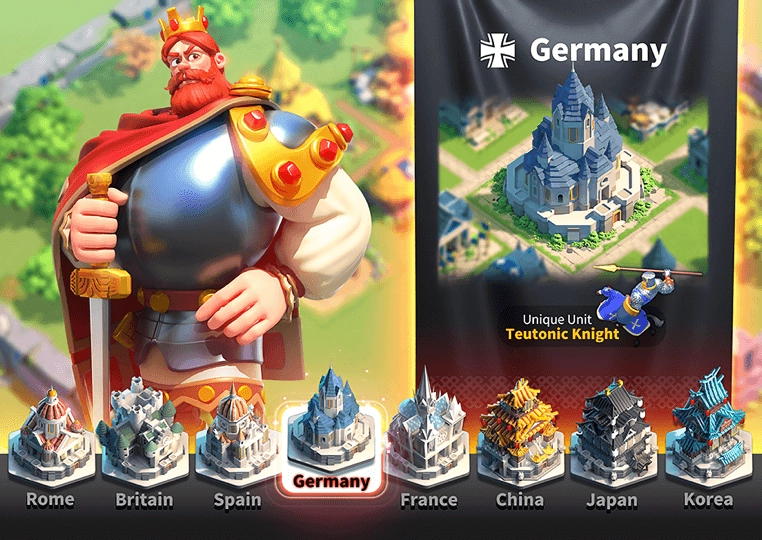
Rise of Kingdoms features multiple historical civilizations, each offering its own architecture, bonuses, special units, and starting identity.There is no single civilization that is automatically best for every player.
Your ideal choice depends on your stage of progression, preferred troop type, activity level, combat goals, and whether you care more about development speed, training efficiency, gathering, open-field fighting, or specialized military bonuses.
For beginners, economic and development bonuses can be especially useful because they accelerate the account-building phase.Later, many experienced players change civilizations to better support their main troop type or combat role.
A dedicated Rise of Kingdoms civilization guide or civilization tier list can compare every civilization in detail and explain when switching becomes worthwhile.
How Do Commanders Work in Rise of Kingdoms?
Commanders are one of the most important long-term investment systems in Rise of Kingdoms.Historical figures serve as leaders for your armies and can be developed through levels, stars, skills, talents, and other progression systems. Different commanders perform better in different situations, so simply owning a powerful commander is not enough.
You also need to understand what that commander is designed to do.Some excel in open-field battles. Others are better for rallies, defending structures, hunting barbarians, gathering resources, supporting allies, or leading particular troop types.This is why commander investment should always have a purpose.
Primary and Secondary Commanders
Marches can use commander pairings, making synergy especially important.The primary commander determines important parts of the march setup, while the secondary commander contributes skills and additional combat value.Strong Rise of Kingdoms commander pairings usually combine commanders whose skills, troop bonuses, buffs, debuffs, and combat roles support the same objective.Two individually strong commanders are not necessarily a strong pair.
Do Not Upgrade Every Commander
One of the most common mistakes for new players is trying to develop too many commanders at the same time.Commander sculptures, experience, stars, equipment, and other materials become increasingly valuable as your account grows.
Focus first on commanders that solve an immediate need or remain useful for a meaningful period of progression.
A complete Rise of Kingdoms commander tier list can help identify the strongest options, while individual commander build guides can explain talents, skills, equipment, pairings, and investment priority in greater detail.
What Are the Main Troop Types?
Army composition plays a major role in Rise of Kingdoms combat.
Infantry, cavalry, and archers form the core specialized troop categories, while siege units serve more specialized purposes.As your account develops, commander skills, civilization bonuses, technology, equipment, and formations can increasingly reward specialization.
Rather than building armies without a clear plan, try to understand which troop type matches the commanders and content you intend to prioritize.
Infantry
Infantry-focused armies are often associated with durability and sustained frontline combat. Their exact performance depends heavily on the commanders, equipment, technology, and battlefield environment supporting them.
Cavalry
Cavalry armies are commonly valued for mobility and their ability to move around large battlefields quickly. This can make them attractive for players who enjoy active open-field combat and repositioning.
Archers
Archer armies can provide strong offensive potential when supported by the right commander pairings and technology. Like every specialized troop type, their effectiveness depends on the complete march rather than troop choice alone.
Siege Units
Siege units should generally be treated differently from your primary combat troops. They are particularly useful for gathering and specialized strategic tasks, so sending them into the wrong battle can create unnecessary losses.
A full Rise of Kingdoms troop guide can eventually cover troop counters, tier progression, training priorities, hospital management, and how to choose a main troop type.
How Should You Manage Resources?
Food, wood, stone, gold, speedups, Action Points, Gems, sculptures, and equipment materials all compete for your attention.
Efficient players do not simply collect more resources. They decide when those resources are worth spending.Whenever your marches are idle, gathering can create additional value. Keeping resource items stored until they are actually needed can also make resource management easier than immediately opening everything.
Large amounts of resources eventually disappear very quickly during troop training, healing, research, and major upgrades, so long-term planning matters.
Build a Daily Routine
A simple routine can prevent a surprising amount of lost progression.Check building and research timers, train troops, collect available rewards, send gatherers, use Action Points efficiently, participate in alliance activities, and review current events before spending large amounts of resources.
Consistency usually matters more than logging in randomly and spending everything at once.
What Should You Spend Gems On?
Gems are one of the most flexible resources in Rise of Kingdoms, which also makes them easy to waste.
They can interact with VIP progression, special shops, events, progression items, and other account systems. Because the best use can change depending on your account stage, spending Gems without a plan is rarely ideal.
Before using a large number of Gems, ask whether the purchase provides permanent account value, helps you reach an important milestone, or contributes toward a high-value event.
A dedicated Rise of Kingdoms Gems guide can later explain the best priorities for beginners, F2P Governors, low spenders, and competitive players. Players who choose to purchase in-game items can also check the Rise of Kingdoms top-up page before spending, while still planning Gems and other premium resources around their long-term account goals.
Why Is VIP Important?
VIP progression provides long-term account benefits and becomes more valuable as your account grows.Unlike temporary boosts, permanent bonuses continue contributing to your development every day.For this reason, experienced players often treat VIP as a long-term progression system rather than something to ignore until late game.
However, the right investment depends on your current account, available Gems, event schedule, and other priorities.Future VIP guides can cover important VIP milestones and when spending Gems on VIP Points makes sense.
Why Should You Join an Active Alliance?
Rise of Kingdoms is fundamentally built around cooperation.
An active alliance can help accelerate development, provide access to alliance rewards and territory, organize group activities, coordinate military objectives, and protect members through collective strength.
As wars become larger, individual account strength becomes only one part of success.Communication and positioning matter just as much.
Alliance Territory Matters
Alliance territory is more than a visual border on the map. Territory expansion can influence access to resources, strategic structures, passes, and future military objectives.
This makes alliance placement and leadership important even for players who do not personally lead rallies.
Follow Alliance Instructions During War
Uncoordinated players can accidentally weaken an otherwise strong alliance.
During major battles, follow markers and leadership instructions, avoid filling rallies with inappropriate troops, understand where your alliance wants you to teleport, and do not start unnecessary engagements that consume resources before important objectives.
Good coordination can turn many average accounts into a much stronger fighting force.
What Is KvK in Rise of Kingdoms?
Kingdom versus Kingdom, commonly called KvK, is one of the major long-term competitive goals in Rise of Kingdoms.
Instead of fighting only against players from your immediate environment, participating kingdoms eventually compete in larger seasonal conflicts involving alliances, territory, objectives, resource management, rallies, garrisons, field battles, and diplomacy.
KvK is also where poor early investment decisions become much easier to notice.
A player may have impressive account Power but still struggle if their commanders, troop specialization, equipment, technology, healing resources, or alliance coordination are weak.
Prepare Before KvK Starts
Preparation should begin before major fighting starts.
Build a useful set of commander pairings, maintain a healthy troop supply, save enough resources for healing, accumulate useful speedups, strengthen important technologies, and communicate with your alliance about your expected role.
You do not need to be the strongest player in the kingdom to contribute.
Lower-power and developing accounts can still gather resources, reinforce structures when requested, join appropriate rallies, help alliance members, participate in objectives, and support the broader kingdom strategy.
A complete Rise of Kingdoms KvK guide can later explain preparation, Lost Kingdom progression, fighting roles, resource planning, rewards, and common mistakes in much greater detail.
How Do Events Affect Progression?
Events are a major part of efficient account growth.
Some encourage building or research, others reward troop training, barbarian hunting, gathering, commander development, or competitive performance.
The key principle is resource timing.
If you already intend to upgrade a commander, train a large number of troops, or complete expensive research, doing so during a relevant event may provide extra rewards for the same investment.
Avoid spending every resource immediately just because it is available.
A regularly updated Rise of Kingdoms events guide can become especially useful for explaining active events, reward priorities, preparation requirements, and whether an event is worth committing resources to.
How Important Is Commander Equipment?
As players move deeper into competitive content, commander strength is no longer determined only by level and skills.Equipment and other combat progression systems can create meaningful differences between marches.This is another reason not to divide materials randomly across too many commanders.
Build complete marches step by step. Improving one reliable combat setup is often more useful than owning several partially developed setups that cannot perform consistently.
Individual commander build guides can later include recommended equipment alongside skills, talents, pairings, and troop choices.
Should You Create a Farm Account?
Many active Rise of Kingdoms players eventually use additional cities or farm accounts to support resource production.A farm account can gather resources that help reduce pressure on your primary city, especially once training, research, upgrades, and healing become expensive.
However, farms also require additional management.New players should first learn the core game on their main account before turning multiple farms into another daily obligation.
A future Rise of Kingdoms farm account guide can cover civilization choices, gathering commanders, development priorities, resource transfers, and efficient farm routines.
What Are the Biggest Beginner Mistakes?
Most early mistakes come from spending valuable resources before understanding their long-term value.
Common problems include investing heavily in too many commanders, wasting universal materials, ignoring an active alliance, leaving builders or research idle, opening more resource items than necessary, spending Gems without a plan, fighting battles with no strategic objective, and using valuable speedups simply because a timer feels long.
Another major mistake is chasing Power alone.Power is useful as a broad indicator of account development, but efficient military performance comes from the combination of technology, commander quality, troop strength, equipment, resources, and player decisions.
A lower-Power account with a focused build can sometimes be more useful than a larger account that has invested everywhere without a clear plan.
F2P vs. Spending: Can You Play Rise of Kingdoms for Free?
Rise of Kingdoms can be played without spending money, but free-to-play progression rewards patience, resource management, alliance activity, and careful investment.
F2P players generally have less room for inefficient decisions because premium resources and high-value commander materials accumulate more slowly.
Low spenders and heavier spenders can accelerate progression, but spending does not remove the need for good strategy. Buying resources and immediately investing them into weak commanders or low-priority upgrades can still leave an account behind more carefully planned players.
The most useful approach is to decide your budget first and then spend according to long-term account goals rather than reacting to every new offer. If you decide to spend, use a trusted Rise of Kingdoms recharge option and keep purchases aligned with the commanders, VIP milestones, and progression systems you actually plan to develop.
What Should You Focus on as Your Account Gets Stronger?
Rise of Kingdoms changes as your city develops.
Early progression is mostly about unlocking systems and building a stable economy. Mid-game progression becomes increasingly focused on commander development, troop specialization, alliance participation, technology, and preparing for large battles.
Long-term players spend more time optimizing complete marches, equipment, combat statistics, resources, seasonal content, and kingdom strategy.
Your priorities should therefore evolve with your account.Do not continue following beginner advice forever simply because it worked during your first week.
Rise of Kingdoms Progression Checklist
For a healthy long-term account, keep your City Hall and important buildings progressing, maintain continuous research, train useful troops, specialize your strongest commander pairings, gather whenever marches are available, manage Gems and speedups carefully, join an active alliance, participate in high-value events, prepare resources before major wars, and gradually build complete combat marches instead of scattered investments.
The exact priority will change as your account develops, but these fundamentals remain useful throughout most stages of the game.
Final Thoughts
Rise of Kingdoms is not a game that can be mastered through Power alone.Successful Governors combine efficient city development, strong commander investment, troop specialization, technology, resource planning, alliance teamwork, and battlefield awareness.
For beginners, the best strategy is to build a strong foundation without wasting limited resources. For experienced players, the challenge becomes turning those accumulated resources into efficient marches and meaningful contributions during alliance wars and KvK.
As the game continues to receive new commanders, events, balance changes, and competitive content, your exact strategy may evolve. The fundamentals, however, remain the same: plan your investments, strengthen the systems that support your main armies, work with your alliance, and prepare before important battles begin.
Frequently Asked Questions
Is Rise of Kingdoms beginner-friendly?
Rise of Kingdoms is easy to start but becomes significantly more complex as commanders, troop specialization, technology, alliances, events, and large-scale PvP become more important. Beginners should focus on learning the core progression systems before worrying about advanced combat.
What should I upgrade first in Rise of Kingdoms?
City development, important prerequisite buildings, research, troop training, and a small number of useful commanders should receive most of your early attention. Avoid trying to upgrade everything equally.
What is the best civilization in Rise of Kingdoms?
There is no universal best civilization for every account. The ideal civilization depends on your progression stage, troop specialization, combat style, and development goals.
Who are the best commanders in Rise of Kingdoms?
The strongest commanders depend on the current meta, troop type, game mode, available pairings, and your account progression. A commander that is excellent for open-field combat may not be the best choice for gathering, rallies, garrisons, or PvE.
Should I save universal commander sculptures?
Yes. Valuable universal materials should generally be used carefully. Avoid investing them simply because you have unlocked a new commander. First decide whether that commander fits your long-term lineup.
Is joining an alliance necessary?
Joining an active alliance is one of the most important parts of Rise of Kingdoms progression. Alliances provide development support, rewards, territory, coordinated activities, and access to the larger competitive side of the game.
What is KvK in Rise of Kingdoms?
KvK means Kingdom versus Kingdom. It refers to large-scale competitive content in which kingdoms and alliances compete through objectives, territory control, field battles, rallies, garrisons, and coordinated strategy.
Can F2P players enjoy Rise of Kingdoms?
Yes. Free-to-play players can progress effectively, but resource efficiency and patience are especially important. Careful commander investment, alliance participation, event planning, and consistent activity help compensate for slower progression.
Should beginners spend Gems immediately?
Usually not. Gems are flexible and valuable, so beginners should understand long-term priorities before making large purchases. Permanent progression and high-value event opportunities are generally more important than impulsive spending.
What is the most important thing to avoid as a new player?
Avoid unfocused investment. Spreading commander materials, Gems, speedups, and resources across too many unnecessary upgrades can slow your account much more than simply progressing at a steady pace.